Most leadership writing treats complexity as an obstacle to be reduced. This book treats it as the medium itself—organizations governed by entropy, and leadership as the continuous transformation of uncertainty into structured, adaptive action. It calls that work Lambda Leadership—holding an organization at the edge of chaos, the productive boundary where innovation and stability coexist.
Your organization is not a machine. Nearly everything you have been taught about leading one assumes otherwise.
That assumption is why the fixes stop working. You added the quality gate in March. The acceptance-criteria template in April. Last week you broke the work into finer components because someone said the bottleneck was granularity. Your team has never been more efficient. It has also never shipped less.
This is not a failure of execution. It is a category error, and it has a physics.
Refining Reality begins where leadership books refuse to—at the foundations. Four chapters take you through the sciences that actually govern the systems you lead:
Not as analogy. As mechanism. By the end of Part One you will understand why carefully built plans dissolve before work begins, why the same problem returns wearing new clothes, and why the most capable organizations operate at the edge of chaos rather than fleeing it.
From those foundations, a working model. Organizations process information across two axes — rationalism and empiricism, strategic and tactical—producing four computational functions that convert uncertainty into ordered action: Object State, Strategic Expansion, Architectural Landscape, State Collapse. The book shows how these functions communicate through Macro and Micro Loops, what breaks when a loop is severed, and how entropy and time extend the model into Spiralspace—which explains why a capability that works in one organization cannot be transplanted into another.
Four principles for leading a computational system: integrate the whole, architect living feedback, cultivate evolutionary dynamics, embody Lambda Leadership.
This book asks something of you.
It is not a passive read. The shift it describes doesn't arrive by reading about it. Every chapter closes with Refining Reality Reflections—journal prompts that take the ideas out of the abstract and into your circumstances, ending in something specific you'll do that week. That's where the integration happens.
Diagnostics support the work—scored organizational assessments with interpretation bands, symptom profiles and diagnostic questions, and recognition patterns for the failure modes you'll find yourself in.
Work them honestly and the book will tell you uncomfortable things about the organization you run. Skim them and you will have read a theory.
The power you gain is the ability to perceive dimensions of your organization that were always there and always invisible—and to architect the conditions where it refines reality without you directing every move.
Bring a pen.
A reference work, built to be used. 520 pages across thirteen chapters, with extensive figures, a 42-page glossary of terms, and a full bibliography spanning thermodynamics, information theory, complexity science, and philosophy. The mathematics is present and rigorous for readers who want it; every concept is also built intuitively for those who don't.
Examples come from software and technology organizations, where computational thinking is native and entropy's effects are visible fastest. The mechanisms are general. Any organization contending with information, coordination, and adaptation runs on them.
Every organization works within two tensions. One is between the map and the territory: the plans and models we build versus the reality we actually meet. The other is between strategy and tactics: the coarse-grained view of where we're heading versus the fine-grained work of getting there. Refining Reality crosses these two axes to reveal four distinct domains: Object State, Strategic Expansion, Architectural Landscape, and State Collapse. Each handles a different kind of uncertainty, and each fails in its own predictable way when it's neglected or overworked.
The quadrants aren't boxes for sorting people or teams. They're a map of the territory every organization already moves through, whether it sees it or not. Seeing that map is the first step toward moving through it deliberately.
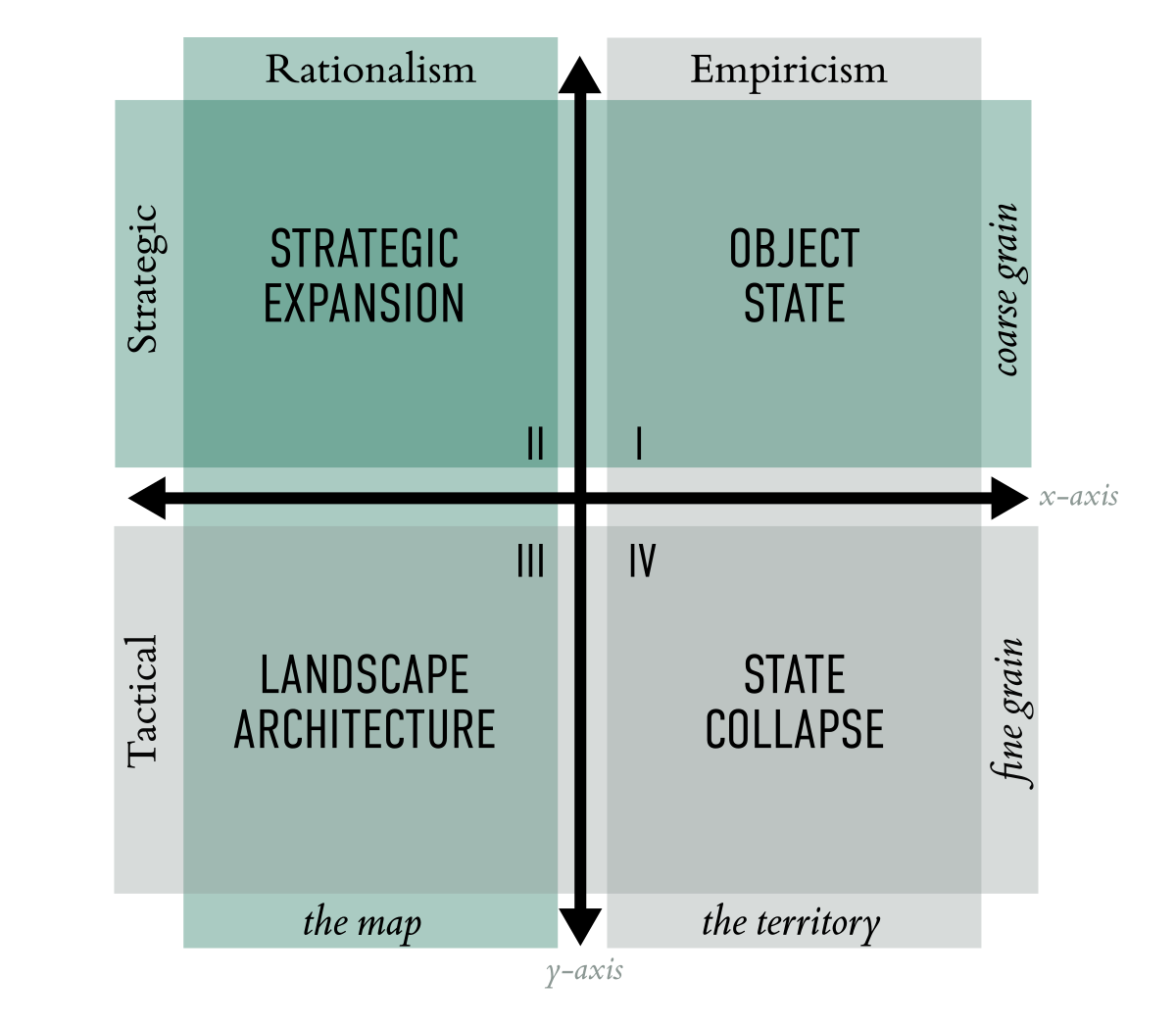
Figure 5.4: The Four Quadrants of Refining Reality
Each quadrant does a specific job. It isn't just a phase of work but a distinct computation that transforms information. Object State filters raw, noisy data into structured insight about what's actually happening. Strategic Expansion takes that insight and opens up possibilities, exploring what could be before choosing what should be. Architectural Landscape turns strategic direction into frameworks that bridge vision and action. State Collapse converts those frameworks into real outcomes, and in doing so produces fresh evidence about the world.
No single function is enough. Organizations strong in strategy but weak in observation build elegant plans on untested assumptions. Organizations strong in execution but weak in architecture work hard in every direction at once. The power lies in all four working together.
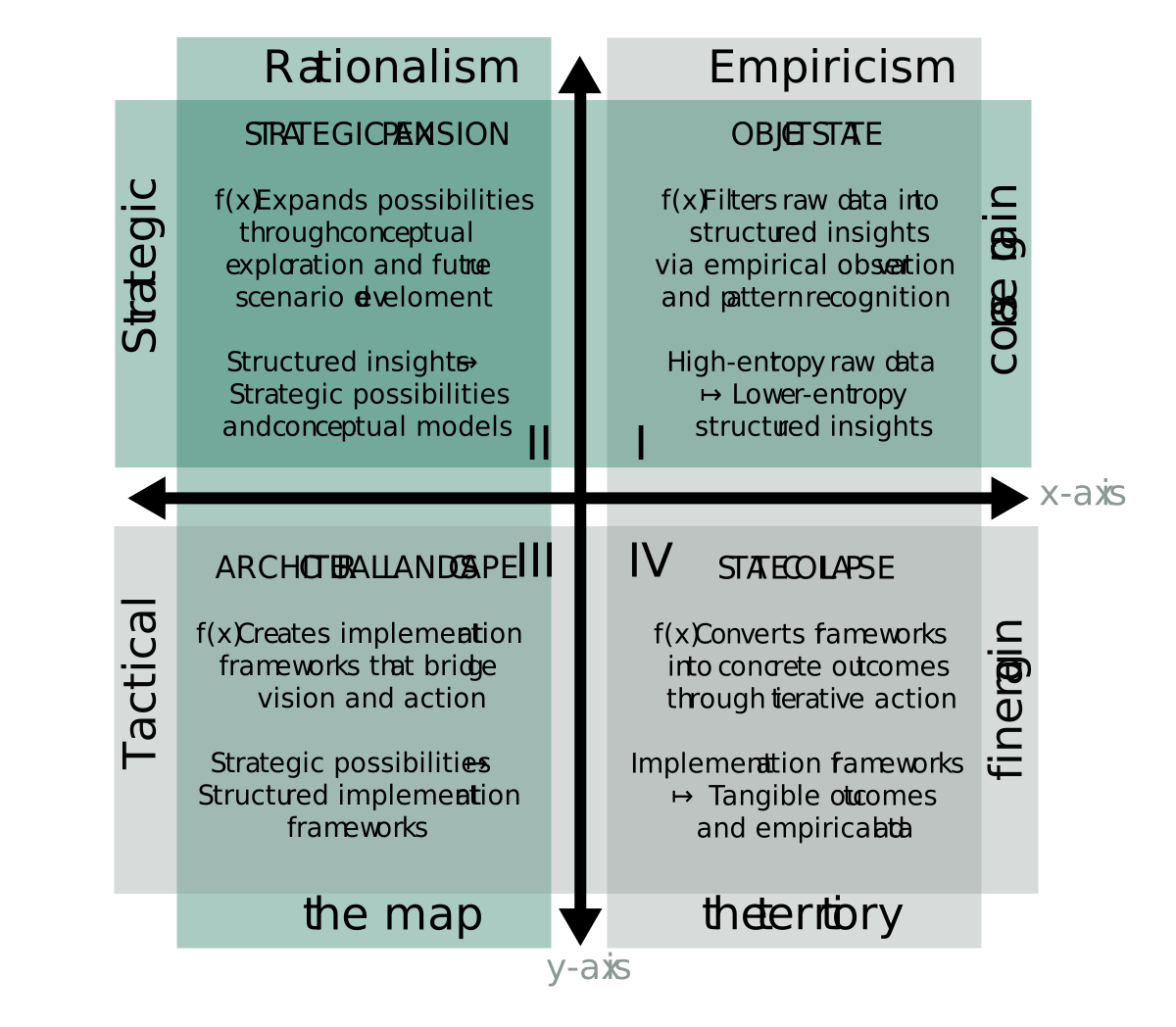
Figure 5.6: The Four Functions and Transforms
The functions come alive when they're connected. The Macro Loop is the circulation that links them. Observation informs strategy, strategy shapes frameworks, frameworks guide action, and the results of action flow back as new observation. Each quadrant's output becomes the next quadrant's input.
This isn't a process to run once a year. It's the main pathway through which an organization learns. When it flows well, each cycle leaves the organization with a sharper understanding than the one before. When it breaks down, information gets lost, distorted, delayed, or overloaded between quadrants. Strategy drifts from reality, and effort stops turning into results. Refining Reality shows you how to see where your loop is breaking, and how to repair it.
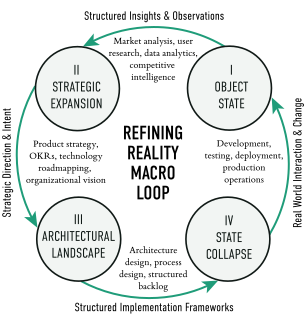
Figure 6.1: Refining Reality Macro Loop's Counterclockwise Flow
This premium hardcover is available exclusively through The Shift Complex Store.
Binding: Case Bound Hardcover
Trim Size: 6"x9" US Royal
Pages: 520
ISBN: 979-8-9966859-0-5
Retail Price: $49.95
Author: Todd D. Lovett

Todd Lovett is an organizational strategist and team coach who designs organizations for performance. He spent nearly three decades in software, first engineering computer systems and then the people systems that produce them. Refining Reality grew out of that shift—from the merely complicated work of writing code to the genuinely complex work of human organization.
His work usually begins where organizations are stuck. A program has spent its budget with nothing to show. A strategy sounds right but can't be executed. Teams are busy but can't agree on what matters. Todd makes the real situation visible, gives strategy a shape teams can act on, designs the structure that connects intent to action, and gets working results flowing again. Each cycle feeds evidence back into the next decision, so leaders work from facts rather than opinion. He has done this at scale, including a modernization program of nearly 300 people at one of the world's largest retailers. When something hard needs to be said, he is often the one who says it, in a way that brings people together and leads to action.
He lives on a homestead on Clinch Mountain, in the ridge-and-valley country of northeast Tennessee.